Planning a full high school year involves more than choosing a few textbooks.
Teachers and homeschool parents may need to coordinate courses, credits, semester timelines, unit goals, assessments, supplies, and long-term graduation plans.
This free printable high school curriculum planner brings those details together in one reusable PDF.
The pages are intentionally flexible, so you can adapt them to one student, one class, or an individual course without being locked into a specific school calendar, teaching method, or curriculum provider.
Printable Details
Title: High School Curriculum Planner.
Used For: Organizing annual courses, four-year plans, semester curriculum maps, individual courses, units, assessments, and learning resources.
Page Length: 7.
Paper Size: 8.5 × 11 in (portrait).
File Size: 967 KB.
File Type: PDF.
Color: Black & White.
License: Personal, classroom, and homeschool use.
Image Gallery
At a Glance
Overview
The printable contains seven planning pages followed by an educational use and license notice.
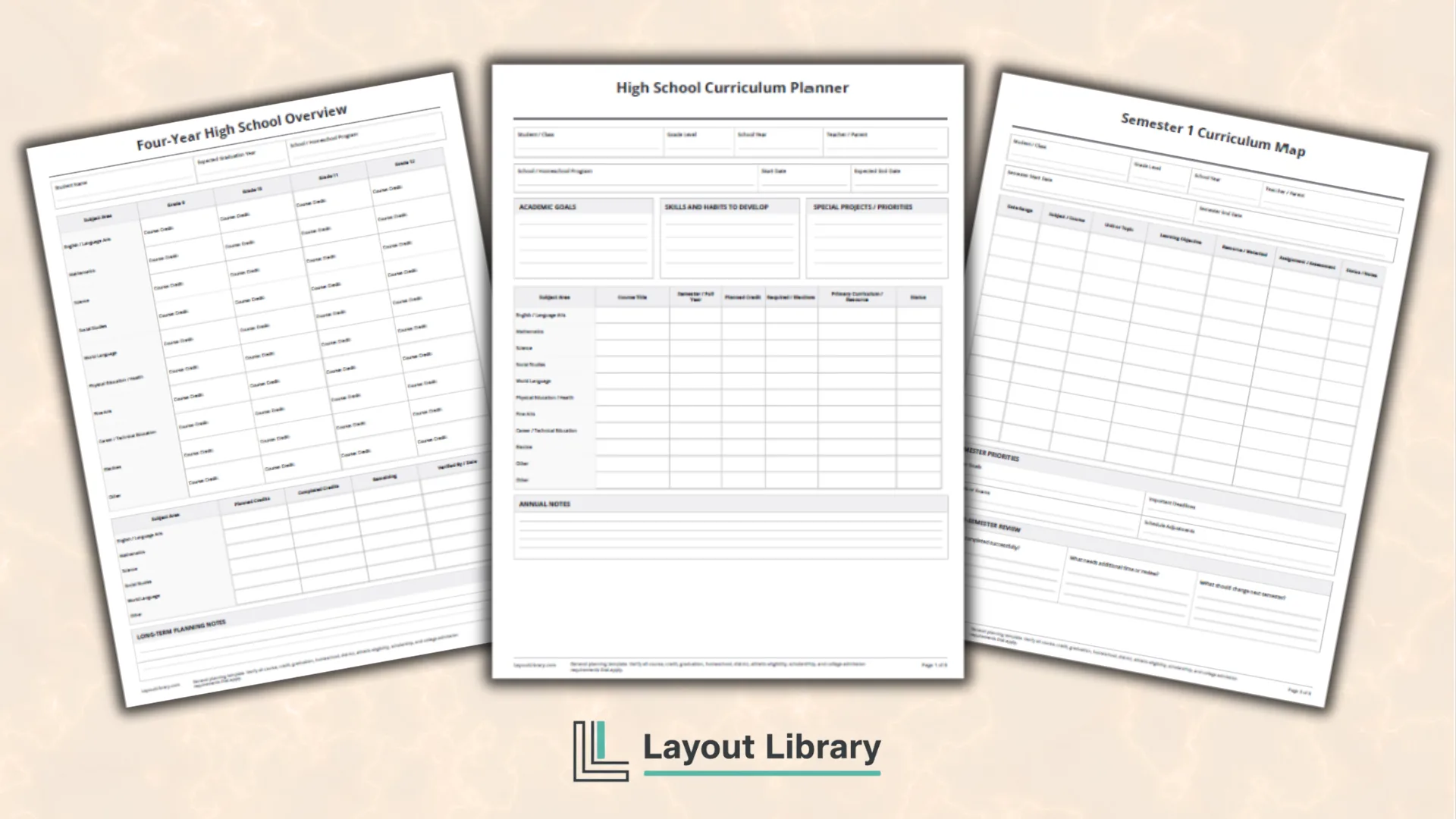
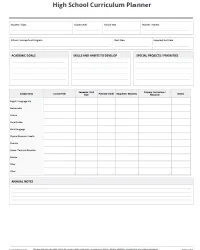
Page one provides an annual curriculum overview. It includes space for school-year information, academic goals, skill development, special priorities, and a course table.
Standard subject areas such as English, mathematics, science, social studies, world language, physical education, fine arts, career and technical education, and electives are already listed, with additional blank rows for custom subjects.
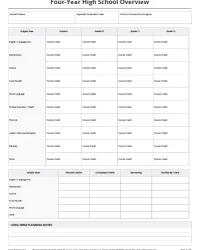
Page two expands the planning process into a four-year high school overview. You can record courses for grades 9 through 12, estimate planned or completed credits, and note long-term considerations such as dual enrollment, advanced coursework, career preparation, or college prerequisites.
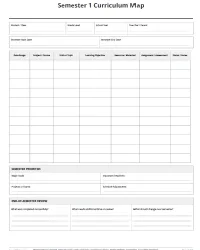
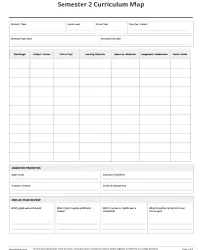
Pages three and four contain separate curriculum maps for the first and second semesters. Both pages use blank date ranges, allowing them to work with traditional schools, block schedules, year-round programs, co-ops, and varied homeschool calendars.
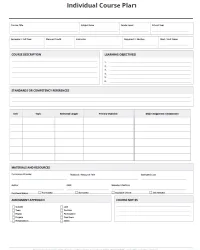
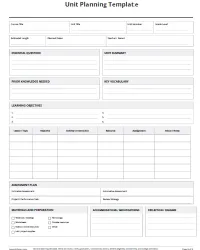
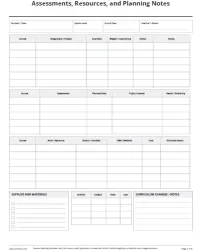
Page five is an individual course plan. Page six is a reusable unit planning template. Page seven brings together assignments, exams, books, websites, supplies, field trips, outside learning, and general curriculum notes.
The final page explains the planner’s intended use and clarifies that it is not an accredited curriculum, official transcript, or universal graduation plan.
How to Use This Curriculum Planner
Begin with the annual overview. Fill in the student or class name, grade level, school year, teacher or parent, and program information. Then identify the most important academic goals and skills for the year.
Next, list each planned course. Record whether it will run for one semester or the full year, whether it is required or elective, and which curriculum or resource you expect to use. Leave the credit field blank until you have verified the correct value for your school or homeschool program.
Use the four-year page to look beyond the current year. This can help you notice missing subject areas, heavy course loads, or prerequisites that should be completed before later classes.
Once the annual direction is clear, move to the semester maps. Add a date range, unit or topic, learning objective, resource, assignment, and status for each planned block. You do not have to complete the entire semester at once. Many educators prefer to map the main units first and add details as the year progresses.
Print one individual course plan for every class that needs more detail. Use it to record the course description, objectives, major units, resources, costs, assessments, and materials.
The unit template can then break a course into smaller sections. It includes space for essential questions, vocabulary, lesson topics, activities, assignments, assessments, accommodations, and reflection.
Tips for Better Curriculum Planning
A useful curriculum plan provides direction while leaving enough room to respond to student progress, unexpected schedule changes, and new opportunities.
Keep learning objectives specific enough to guide instruction. Instead of writing “study biology,” you might use “compare the structures and functions of plant and animal cells.”
Review the planner at the end of each semester. Mark what was completed, identify topics that need more practice, and decide what should be moved or adjusted.
Store supporting records with the planner when necessary. Depending on the school or homeschool program, this may include attendance records, completed assignments, grades, portfolios, reading lists, or official transcripts.
Educational Disclaimer
This printable high school curriculum planner is a general educational planning resource.
It is not an accredited curriculum, official transcript, diploma plan, or guarantee that a course or program meets state, district, homeschool, graduation, athletic eligibility, scholarship, or college admission requirements.
Requirements vary by location, school, institution, program, and student.
Teachers, parents, administrators, and students are responsible for confirming current rules with the appropriate school, district, state agency, homeschool authority, college, athletic association, scholarship provider, or other relevant organization.