Chess improves when players stop guessing and start recognizing patterns.
These free printable chess puzzle worksheets make that practice easy to do away from a screen. Each board gives the solver one focused job, from spotting a checkmate to finding a fork, pin, skewer, or discovered attack.
The PDF starts with approachable mate-in-one positions and gradually adds more calculation. It works well for children who already know how the pieces move, adult beginners, homeschool lessons, school chess clubs, tutoring sessions, or independent practice at home.
Printable Details
Title: Chess Puzzle Worksheets.
Used For: Chess lessons, homeschool practice, classrooms, tutoring sessions, chess clubs, and independent practice.
Page Length: 5.
Paper Size: 8.5 × 11 in (portrait).
File Size: 79 KB.
File Type: PDF.
Color: Black & White.
License: Personal Use.
Image Gallery
At a Glance
Overview
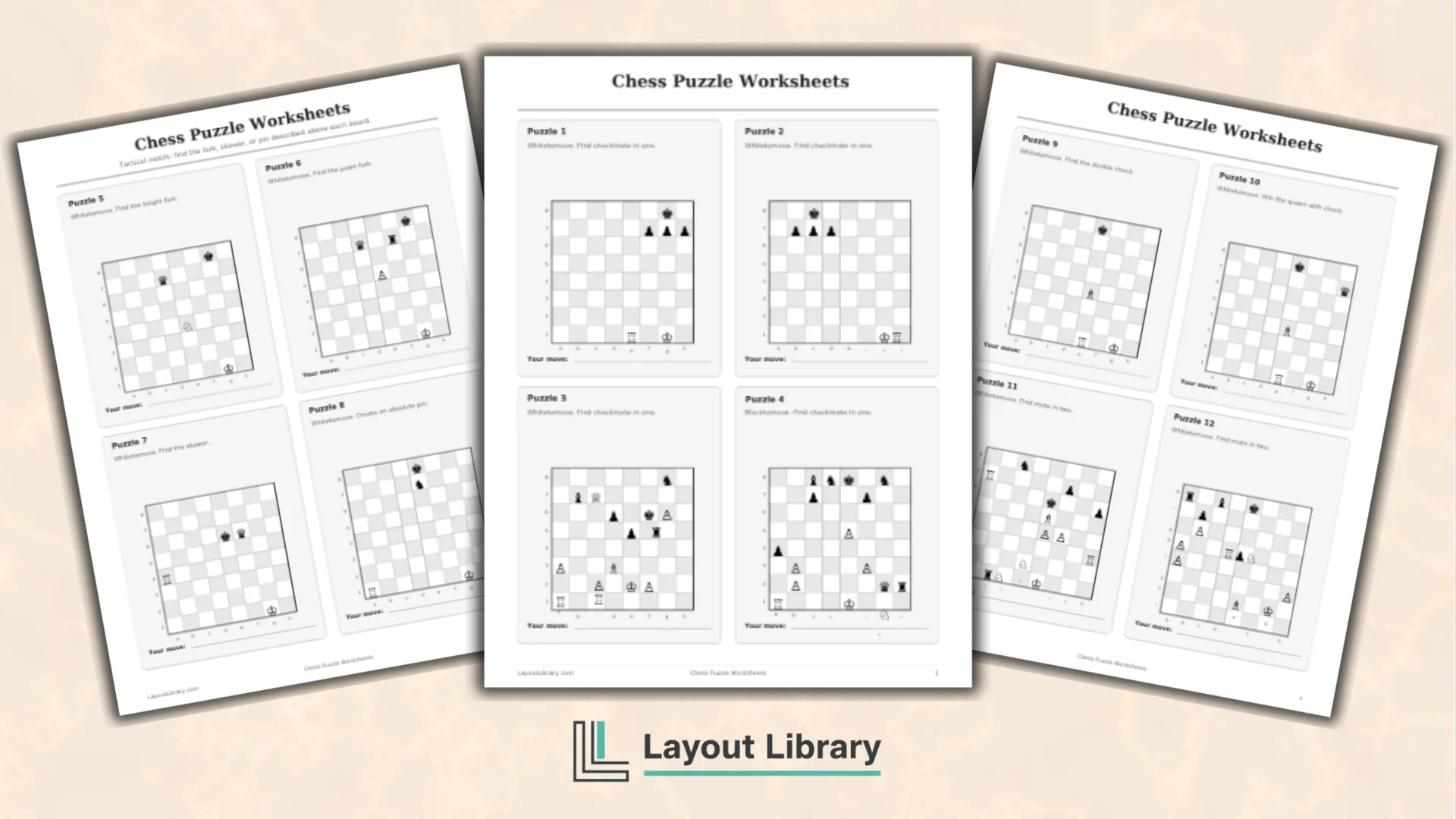
These chess puzzle printable worksheets are designed as a short, progressive practice packet. The first worksheet asks players to find four checkmates in one move.
This encourages the useful habit of checking forcing moves first and noticing when a king has no safe squares.
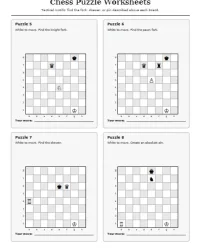
The second worksheet introduces four common tactical motifs. Players look for a knight fork, a pawn fork, a rook skewer, and an absolute pin.
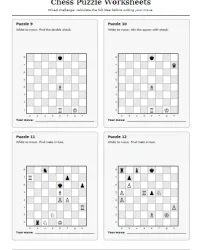
The third worksheet combines ideas and raises the difficulty slightly. It includes a double check, a discovered check that wins the queen, and two mate-in-two positions.
What Is Included in the PDF?
Page one contains four mate-in-one puzzles. Three positions ask White to move, while one asks Black to move so students practice looking at the board from both sides.
Page two focuses on tactical patterns that frequently appear in real games. The objective above each board tells the solver which motif to find, keeping the activity challenging without making it confusing.
Page three provides four mixed challenges. These positions ask the solver to calculate beyond the first visual clue and, for the mate-in-two problems, consider the opponent’s forced response.
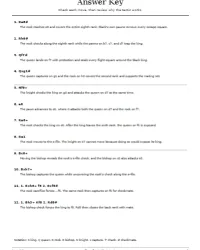
Page four is the answer key. It explains the purpose of every move instead of listing solutions alone. Page five contains personal-use terms, printing notes, and simple instructions for using the packet.
How to Use These Chess Puzzle Worksheets
Start by reading the instruction above the board. Confirm whose turn it is, then scan for checks, captures, and threats. Try to calculate the opponent’s best reply before writing anything down.
Players who know algebraic notation can record moves such as Nf6+ or Re8#. Newer players can write the starting and ending squares instead.
For example, they could write “rook from e1 to e8.” The main goal is accurate visualization and reasoning, not perfect notation on the first attempt.
For a lesson or chess club, give students a few quiet minutes to solve each group independently. Then recreate selected positions on a demonstration board and invite students to explain why the move works.
Asking what squares the king can use, which pieces are attacked, and what would happen after a different move turns the answer review into a stronger learning activity.
Tips for Better Puzzle Practice
Avoid checking the answer after the first guess.
Look at every legal response you can find, especially captures and king moves. If a position feels difficult, set it up on a physical board and move the pieces only after calculating the line in your head.
You can also reuse the worksheets later. Cover the written answers, solve the positions again, and compare how quickly the patterns appear. Repetition helps tactical ideas become easier to recognize during an actual game.