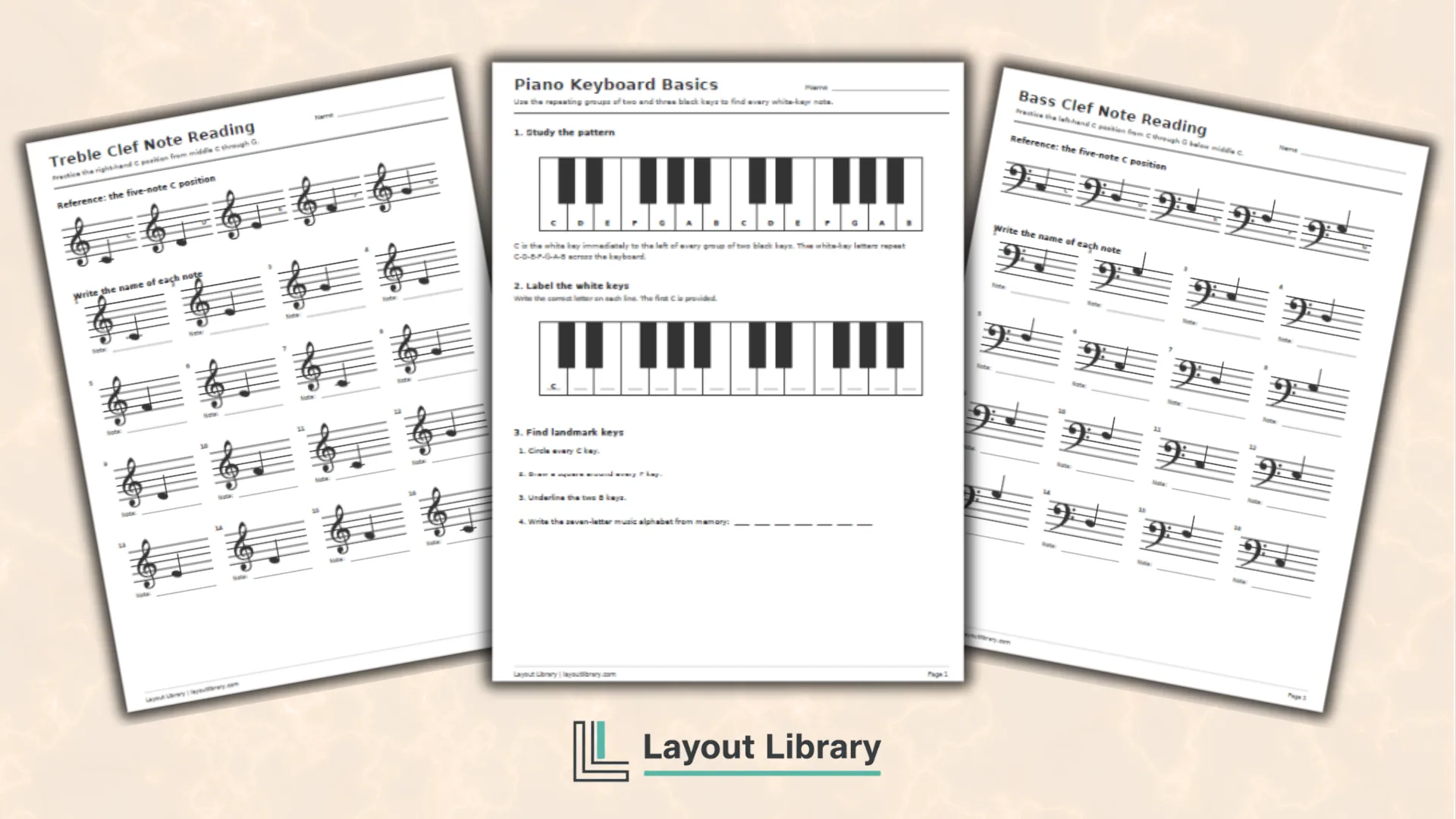
Build early piano skills one clear step at a time with these free printable piano worksheets for beginners.
The pages introduce keyboard landmarks, treble and bass note reading, staff-to-keyboard matching, and simple rhythm counting.
Beginners can practice away from the instrument, then transfer each answer directly to the piano during lessons or independent study with confidence.
Printable Details
Title: Piano Worksheets for Beginners. Used For: First piano lessons, home practice, music classrooms, note-reading review, rhythm activities. Page Length: 7. Paper Size: 8.5 × 11 in (portrait). File Size: 88 KB. File Type: PDF. Color: Black & White. License: Personal Use.
Six focused worksheet pages build keyboard, notation, and rhythm skills without overwhelming a brand-new piano learner.
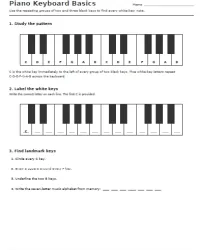
Labeled and blank keyboards help students recognize repeating black-key groups and locate every white-key note confidently.
Separate treble and bass activities reinforce the five-note C positions commonly introduced during early piano lessons.
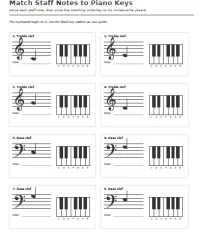
Staff-to-keyboard matching connects written notation with physical key locations through eight short, approachable practice exercises.
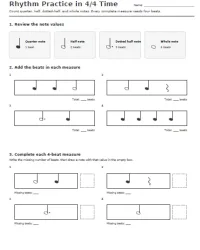
A 4/4 rhythm page covers quarter, half, dotted-half, and whole notes with counting and drawing practice.
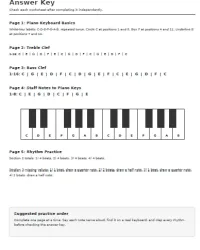
The consolidated answer key supports independent checking, parent-guided practice, and efficient review during short music lessons.
Black-and-white pages save ink while leaving generous writing space for pencils, corrections, and repeated skill checks.
Beginner Piano Skills Included
This worksheet set begins with the visual pattern that makes the piano keyboard easier to understand.
Students study groups of two and three black keys, identify C beside each two-key group, and label the repeating white-key alphabet.
The next pages introduce five notes in each clef. The treble worksheet covers the right-hand C position from middle C through G.
The bass worksheet uses the left-hand C position from C through G below middle C.
Keeping the range small lets students focus on accurate recognition before adding more notes.
What Each Worksheet Covers
Page one combines a labeled keyboard reference with a blank labeling activity and four landmark-key prompts.
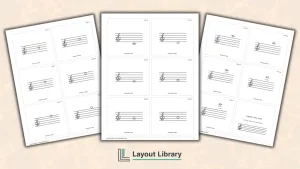
Pages two and three provide reference examples followed by 16 note-identification questions for each clef. Repeated exposure helps learners recognize line, space, and ledger-line positions without relying only on memorized sayings.
Page four asks students to name a staff note and circle its matching key on a miniature keyboard.
Page five introduces note values in 4/4 time, then asks learners to total complete measures and supply missing beats.
Page six gathers every answer in one place for quick, low-friction checking.
How to Use the Worksheets
Start with one page rather than completing the entire set at once.
Ask the learner to say each answer aloud before writing it. After finishing a row, find the same notes on a piano or keyboard.
For the rhythm page, clap or tap each measure before writing the beat total. Count steadily from one through four and hold longer notes for their full value.
When drawing a missing note, check both its shape and its duration. Accuracy matters more than speed during the first few practice sessions.
Use the answer key after the work is complete. If an answer is incorrect, return to the nearest reference row and explain how the student can locate it independently.
Correcting with a strategy builds more durable understanding than simply supplying the right letter or number.
Practice Ideas for Teachers and Families
Turn the keyboard page into a quick scavenger hunt. Call out C, F, or B and ask the learner to point to every matching key on the instrument.
Then reverse the activity by pointing to a key and asking for its letter name. Keep each round short so recognition remains quick and playful.
The note-reading pages also work well as timed review without making speed the main goal. Give the student one minute to complete a single row, then check accuracy together.
Repeat that row later and celebrate fewer hesitations or corrections. This creates visible progress while preserving careful reading habits.
For group lessons, let students compare how they solved an exercise. One learner might identify a note by counting from middle C, while another recognizes its staff position immediately.
Hearing multiple reliable approaches helps beginners become flexible readers instead of depending on one memory trick.
FAQ
Yes. The activities stay within a compact five-note range and explain the keyboard pattern before asking students to work independently. A teacher, parent, or older learner can introduce one reference section at a time, making the pages suitable for the earliest stages of piano study.
No, most questions can be completed with a pencil at a table. Access to a piano or keyboard is helpful afterward because students can locate and play each written answer. That follow-up step turns visual recognition into practical keyboard familiarity.
Yes. The sixth page provides answers for the keyboard labels, treble notes, bass notes, staff-to-keyboard matches, and rhythm exercises. Encourage learners to finish a section before checking it, then use any missed questions as a focused review list for the next practice session.