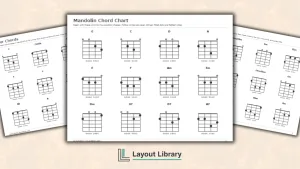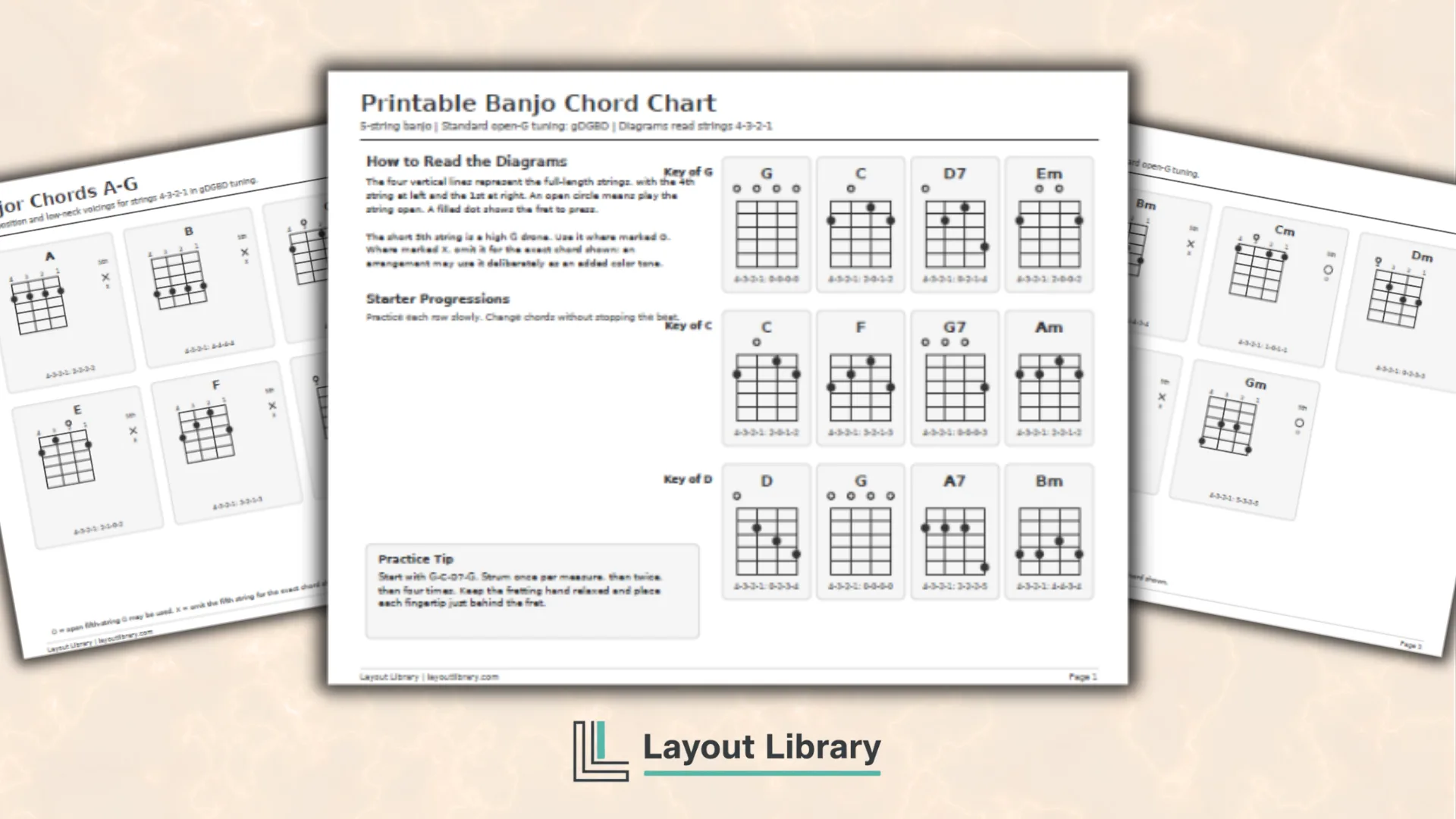
Keep chord shapes close during practice with this printable banjo chord chart.
The five-page reference covers beginner progressions plus major, minor, and dominant seventh chords in standard five-string open-G tuning.
Clear fretboard diagrams and number patterns help you review a shape and return to playing quickly.
Printable Details
Title: Banjo Chord Chart.
Used For: Beginner practice, chord changes, lessons, jam preparation, song accompaniment.
Page Length: 5.
Paper Size: 8.5 × 11 in (landscape).
File Size: 65 KB.
File Type: PDF.
Color: Black & White.
License: Personal Use.
Image Gallery
At a Glance
A Practical Five-String Banjo Chord Reference
This chart is made for a five-string banjo in standard open-G tuning, written gDGBD from the short fifth string through the first string.
Because the open strings already form a G major chord, the first shape requires no fretting. From there, the PDF introduces practical shapes that stay mostly in the open position or low on the neck.
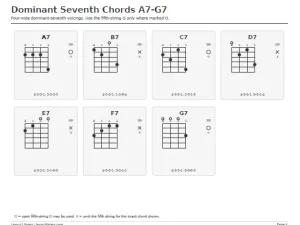
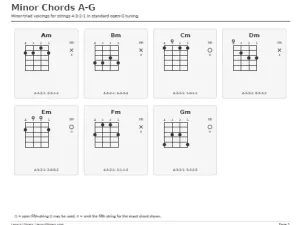
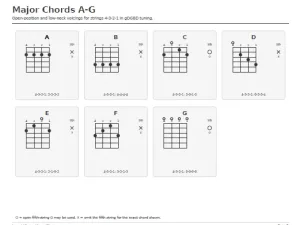
Each diagram shows the four full-length strings, numbered 4 through 1 from left to right. Hollow circles indicate open strings, while solid dots show fretted notes.
The number sequence below each diagram gives the same frets in 4-3-2-1 order, making it useful when you prefer a compact written pattern.
The short fifth string has a special role on a five-string banjo. It is normally tuned to a high G and often works as a drone, but G is not a chord tone in every shape.
The O and X markers help you distinguish shapes that naturally include the open fifth string from exact voicings where it should be omitted.
What’s Included in the PDF
The first page explains the diagram system and presents three starter progressions. You can practice G-C-D7-Em, C-F-G7-Am, and D-G-A7-Bm as short chord-change drills.
These groups introduce common musical relationships without requiring you to scan several pages before beginning.
The next three pages organize the chord library by quality. One page covers the seven natural-note major chords from A through G.
Another gives the corresponding minor chords, and the final chart page presents dominant seventh shapes. This separation makes it easy to compare related fingerings without crowding every chord type onto one sheet.
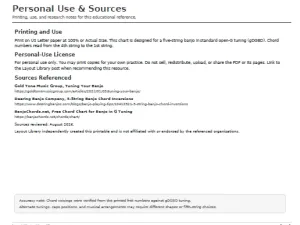
The fifth page contains printing information, personal-use terms, an accuracy note, and the major sources referenced while developing the chart.
It also clarifies that alternate tunings, capo positions, and individual arrangements can call for different shapes or fifth-string choices.
How to Use the Banjo Chord Chart
Tune your banjo to standard open G before using the shapes. Choose one starter progression and form its first chord slowly.
Keep your fingertips just behind the frets, use only enough pressure for a clear note, and check every string individually before you begin strumming or picking a roll.
Practice changing between two chords first. Move back and forth at a steady tempo, then add the third and fourth chords.
One strum per measure gives your fretting hand time to prepare. As the movement becomes comfortable, increase the rhythm to two or four strums without speeding up the underlying beat.
Tips for Clearer Chord Changes
Keep the thumb relaxed behind the neck instead of gripping harder than necessary.
Look for fingers that can remain in place or move only a short distance between shapes. Efficient motion usually matters more than lifting every finger high above the fretboard.
Listen as carefully as you look. A shape can appear correct while one fingertip accidentally touches a neighboring string.
Pick the four main strings separately, correct any muted or buzzing note, then test the complete chord.
Slow, clean repetition builds a more dependable change than rushing through a noisy one.