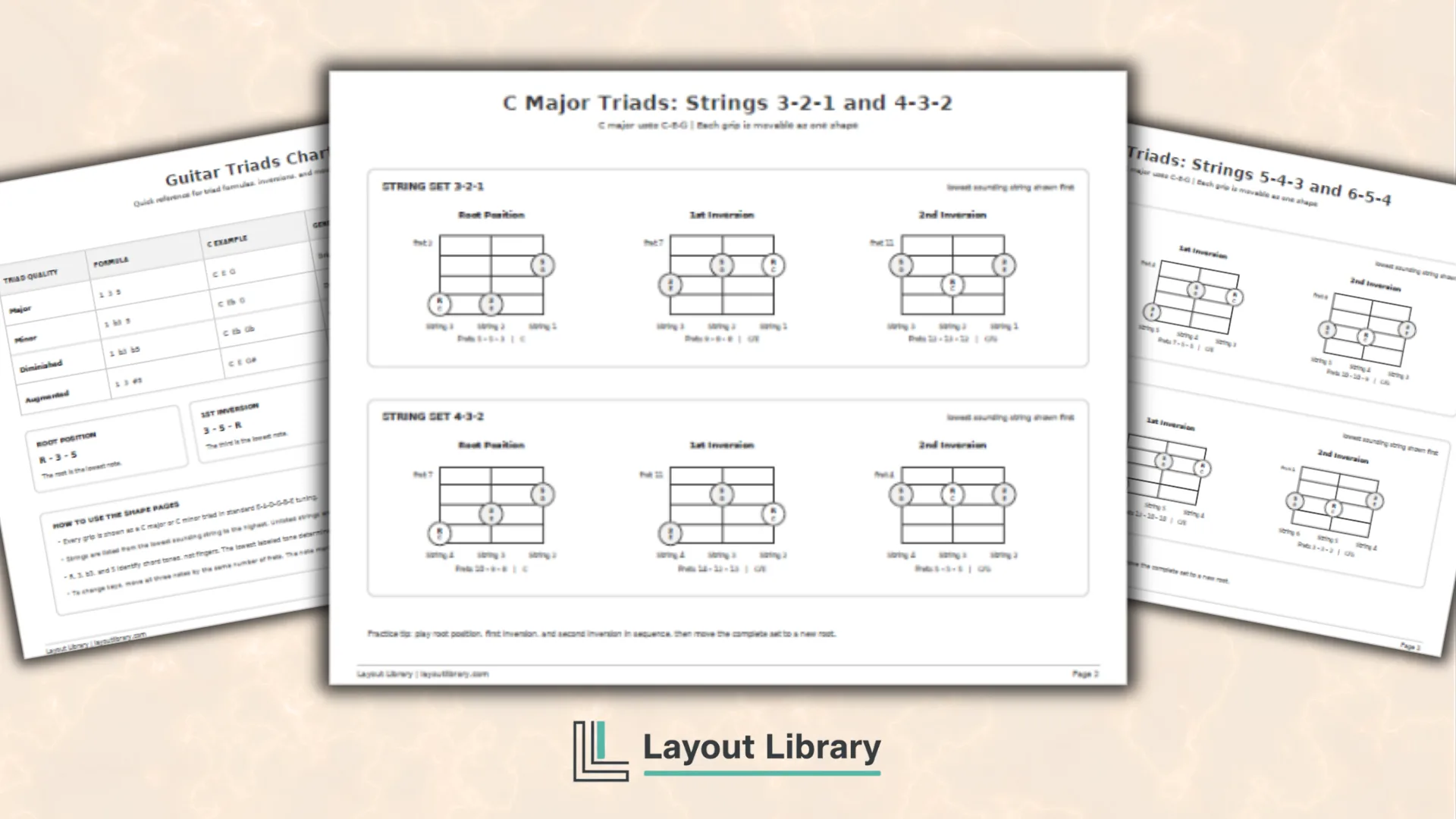
Triads are small chords with a large role on the guitar.
Their three notes make it easier to see chord construction, hear inversions, and connect familiar sounds across the neck.
This printable guitar triads chart covers essential formulas, major and minor shapes, all three inversions, and four adjacent string sets in standard tuning.
Printable Details
Title: Guitar Triads Chart.
Used For: Chord study, inversion practice, fretboard visualization, rhythm guitar, songwriting, and voice leading.
Page Length: 6 pages.
Paper Size: 8.5 × 11 in (landscape).
File Size: 60 KB.
File Type: PDF.
Color: Black & White.
License: Personal Use.
Image Gallery

At a Glance
What’s Included in This Guitar Triads Chart?
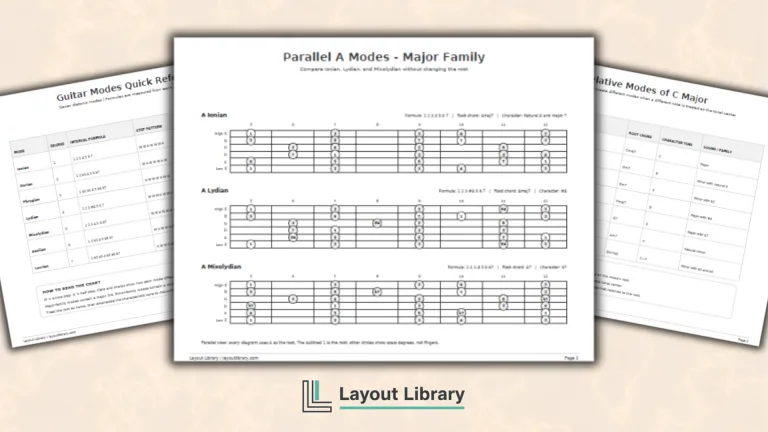
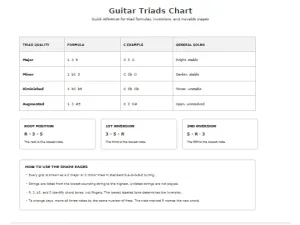
The first page compares major, minor, diminished, and augmented triads by formula, shows each C example, and explains the character of every quality. It also shows how root position and the two inversions reorder the same chord tones.
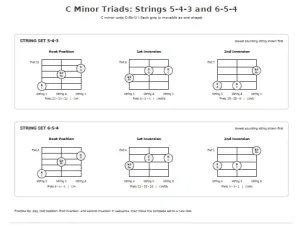
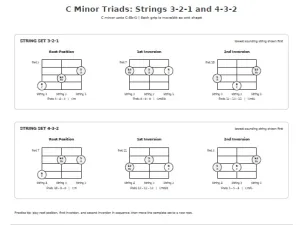
The remaining pages concentrate on major and minor triads because guitarists use these shapes often in songs, accompaniment, arrangement, and fretboard study. Each quality receives two pages so the diagrams stay readable.
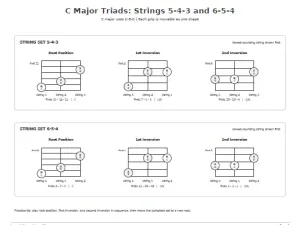
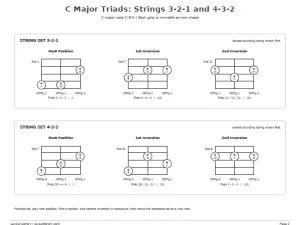
You will find shapes for string sets 3-2-1, 4-3-2, 5-4-3, and 6-5-4. Together, these sets cover every group of three adjacent strings on a standard six-string guitar.
How the Movable Triad Shapes Work
Every diagram starts with a C major or C minor triad. Strings run from the lowest sounding to the highest, while labels inside the circles identify each chord tone. Unlisted strings are not played.
The root is labeled R with a heavier outline. Major shapes label the third and fifth. Minor shapes replace the third with a flat third. The labels explain why each grip sounds major or minor instead of presenting an unexplained fingering.
Each row moves through root position, first inversion, and second inversion. The lowest tone is the root in root position, the third in first inversion, and the fifth in second inversion. Slash-chord labels beneath the diagrams reinforce that bass-note relationship.
Because the grips are movable, you can transpose one by shifting all three fretted notes the same distance. Find the note marked R after the move, and that note becomes the name of the new major or minor chord.
Ways to Practice Guitar Triads
Begin with one string set and one chord quality.
Play the three inversions slowly in order, saying the chord tones aloud. This combines visual recognition, fretboard knowledge, and sound without introducing too many shapes at once.
Next, choose a new root and move the entire three-shape sequence. Check the root note in every inversion rather than relying only on hand position. This habit turns the chart into a movable system that works in all keys.
Use the shapes for voice-leading practice. Choose two progression chords, then locate inversions that keep notes close together. Smaller movements often create smoother rhythm parts than jumps between large open or barre-chord shapes.
Try connecting the nearest inversions through a simple I-IV-V progression to hear smoother chord movement.
Printing and Setup Tips
Print the PDF on US Letter paper in landscape orientation. Select Actual Size or 100% scale to preserve the diagrams. Printer paper suits a study copy, while cardstock creates a sturdier music-stand reference.
The charts assume standard E-A-D-G-B-E tuning. Use only the three strings named in each section and mute the remaining strings.
The circles show musical functions rather than suggested fingers, so choose comfortable fingering based on the fret position and what comes before or after the chord.
Practice with relaxed hands and a clean sound. If a grip causes pain or persistent strain, stop and adjust your wrist, thumb, or fingering before continuing.