Guitar modes can feel abstract until you compare them.
This printable organizes seven diatonic modes into charts and fretboard diagrams that connect formulas, chord families, characteristic tones, and practical positions.
Use during lessons, theory study, improvisation, or songwriting.
Printable Details
Title: Guitar Modes.
Used For: Music theory study, fretboard practice, improvisation, songwriting, guitar lessons.
Page Length: 5 pages.
Paper Size: 8.5 × 11 in (landscape).
File Size: 64 KB.
File Type: PDF.
Color: Black & White.
License: Personal Use.
Image Gallery

At a Glance
Understanding the Seven Guitar Modes
The seven modes are Ionian, Dorian, Phrygian, Lydian, Mixolydian, Aeolian, and Locrian.
They come from the seven degrees of the major scale. Ionian is the familiar major scale, while Aeolian is the natural minor scale. The other modes alter degrees to create distinct colors.
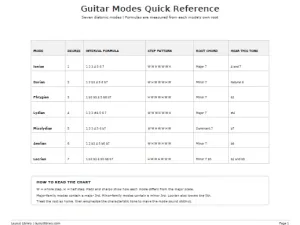
Page one gives you a compact comparison of each formula. It also lists the whole-step and half-step pattern, the seventh chord built on the root, and the tone that helps reveal the mode. This makes the page useful when you need a theory answer.
What the Five Printable Pages Include
The first chart covers the formulas for all seven modes.
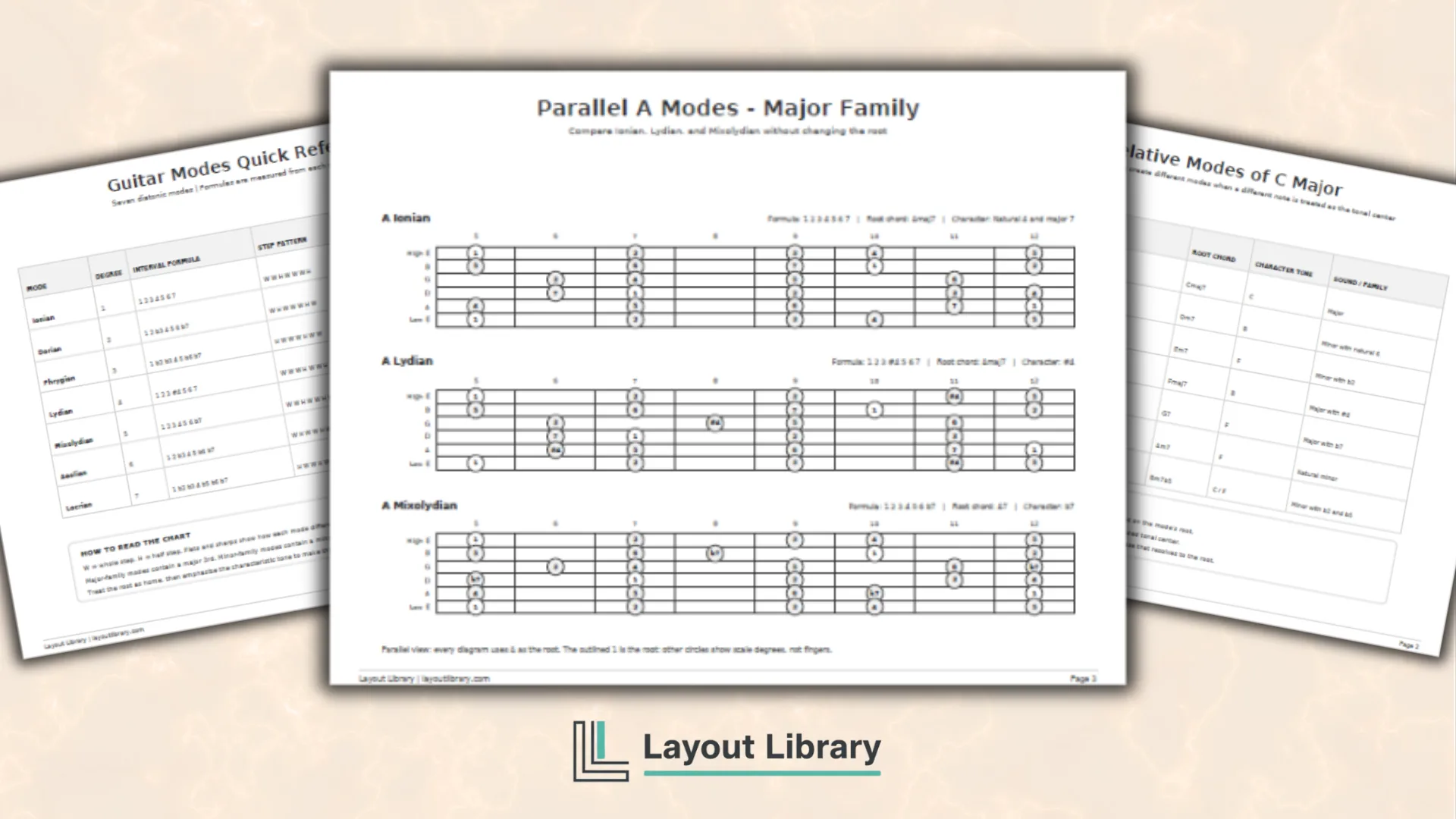
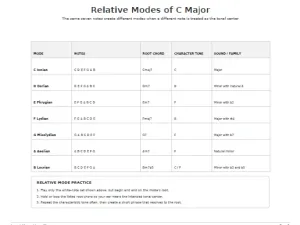
Page two shows the relative modes created from the notes of C major. Every row uses C, D, E, F, G, A, and B, but each centers a different root and chord.
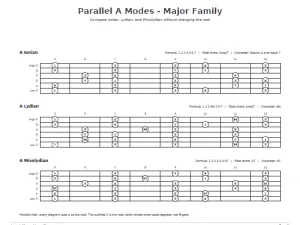
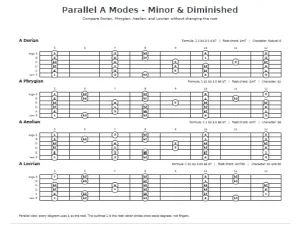
Pages three and four use parallel A modes. Every diagram keeps A as the root, making the changed scale degrees easy to see.
Ionian, Lydian, and Mixolydian appear together as the major family. Dorian, Phrygian, Aeolian, and Locrian appear on the following page as the minor and diminished family.
The fifth page explains printing, diagram orientation, root markers, and permitted personal use.
This key prevents confusion between scale-degree labels and suggested fingerings.
Relative Modes vs. Parallel Modes
Relative modes share the same notes but use different tonal centers. C Ionian and D Dorian, for example, both use the white-note collection.
The difference comes from which note feels like home, which chord supports it, and which characteristic tone receives emphasis.
Parallel modes share one root but use different notes. Comparing A Ionian with A Mixolydian quickly reveals that Mixolydian lowers the seventh.
Comparing A Dorian with A Aeolian shows that Dorian has a natural sixth while Aeolian has a lowered sixth.
Studying both views connects theory relationships with the sound under your fingers.
How to Use the Guitar Mode Charts
Begin with the quick-reference page and choose one mode. Say its formula aloud, then identify its root chord and characteristic tone.
On a relative-mode day, play the C-major note set while beginning and ending on the listed modal root. Loop the root chord so your ear stays anchored to the intended center.
On a parallel-mode day, use the fretboard pages. Play the outlined A roots first, then add the remaining degrees slowly.
Compare one closely related pair, such as Ionian and Lydian or Dorian and Aeolian. Listen for the single changed degree before trying to memorize the entire shape.
The circles show scale degrees, not finger numbers. Choose comfortable fingering based on your hand position, technique, and musical phrase.
Practice ascending, descending, skipping intervals, and resolving short melodies back to the root.
Tips for Stronger Modal Practice
Record a chord drone or loop before improvising.
A stable harmony makes the tonal center clearer and prevents the mode from sounding like a major scale that starts on another note.
Create two- or four-measure phrases that feature the characteristic tone, but do not end every phrase there. Resolve to the root often enough to establish home.
After a shape feels familiar, move the same formula to another root and find the altered degree again.