Sometimes a riff appears faster than you can open an app and set up a score.
A clean sheet of guitar tablature gives you an immediate place to capture the idea.
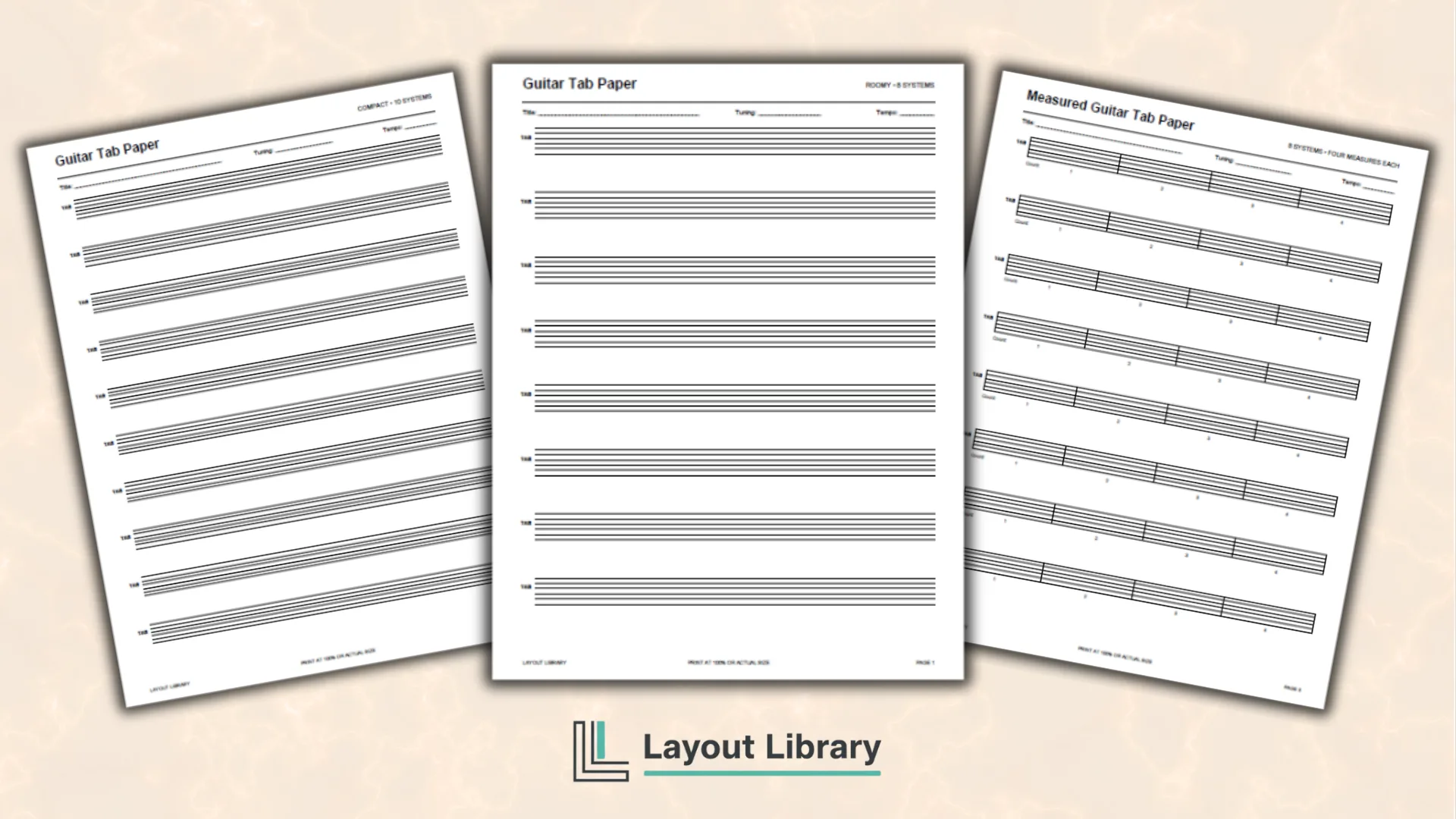
This free printable guitar tab paper includes four practical layouts: roomy lines, compact lines, measured tab, and paired notation with tab.
Printable Details
Title: Guitar Tab Paper.
Included layouts: Roomy tab, compact tab, measured tab, standard notation with tab, and a notation and personal-use guide.
Page Length: 5.
Paper Size: 8.5 × 11 in (portrait).
File Size: 9 KB.
File Type: PDF.
Color: Black & White.
License: Personal Use.
Image Gallery
At a Glance
Overview
Guitar tablature turns the guitar’s six strings into a simple writing system. Each tab staff contains six horizontal lines.
The top line represents the first string, or high E, while the bottom line represents the sixth string, or low E.
Fret numbers are written directly on the string lines, which makes tab especially approachable for guitarists who do not read standard notation fluently.
This PDF keeps those lines thin and easy to write over. It works for acoustic, electric, and classical six-string guitar.
The blank Tuning field also gives you room to note Drop D, an open tuning, or another setup.
What’s Included
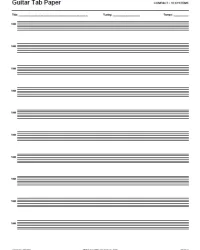
The first page contains eight roomy tab systems. Its open spacing works well for beginners, classroom demonstrations, and handwritten lesson notes.
The second page contains ten compact systems. Use it for longer pieces, practice routines, several short riffs, or different versions of one idea.
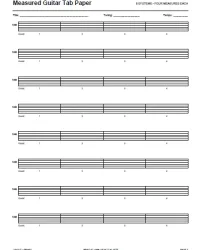
The third page contains eight systems divided into four measures. A count row helps you plan beats. The printed numbers are guides, not a required time signature.
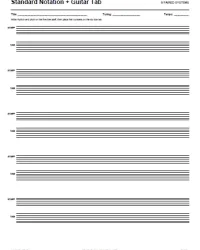
The fourth page pairs five-line music staves with six-line guitar tab. Write notation above and matching fret positions below when tab alone does not communicate enough rhythmic or melodic detail.
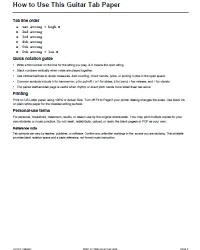
The fifth page explains string order, basic tab marks, printing, and personal-use terms. It is a quick reference rather than a complete guitar lesson.
How to Write Guitar Tab
Write a number on the line that represents the string you want to play. The number tells you which fret to press.
A 0 means to play the open string. When several numbers appear vertically aligned, play those notes together.
You can also add technique symbols. Many guitarists use h for hammer-on, p for pull-off, b for bend, r for release, a slash for slide, and a tilde for vibrato. Conventions vary, so define unusual symbols.
Tab is excellent for showing string and fret positions, but basic tab may not fully explain timing.
Add barlines, beat counts, note stems, chord names, or standard notation whenever the rhythm needs to be clearer.
Printing Tips
Open the PDF in a standard viewer. Select US Letter paper and print at 100% or Actual Size.
Avoid Draft mode if it makes the thin lines uneven. Plain white printer paper works well for everyday practice.
You do not need to print all five pages. Select the exact page number for the layout you want, then print as many personal, classroom, studio, or lesson copies as needed.