Opposite words are easier for young children to understand when they can compare two clear pictures side by side.
These free printable opposites cards give preschool and kindergarten learners 24 common word pairs to explore through matching, sorting, conversation, and hands-on play.
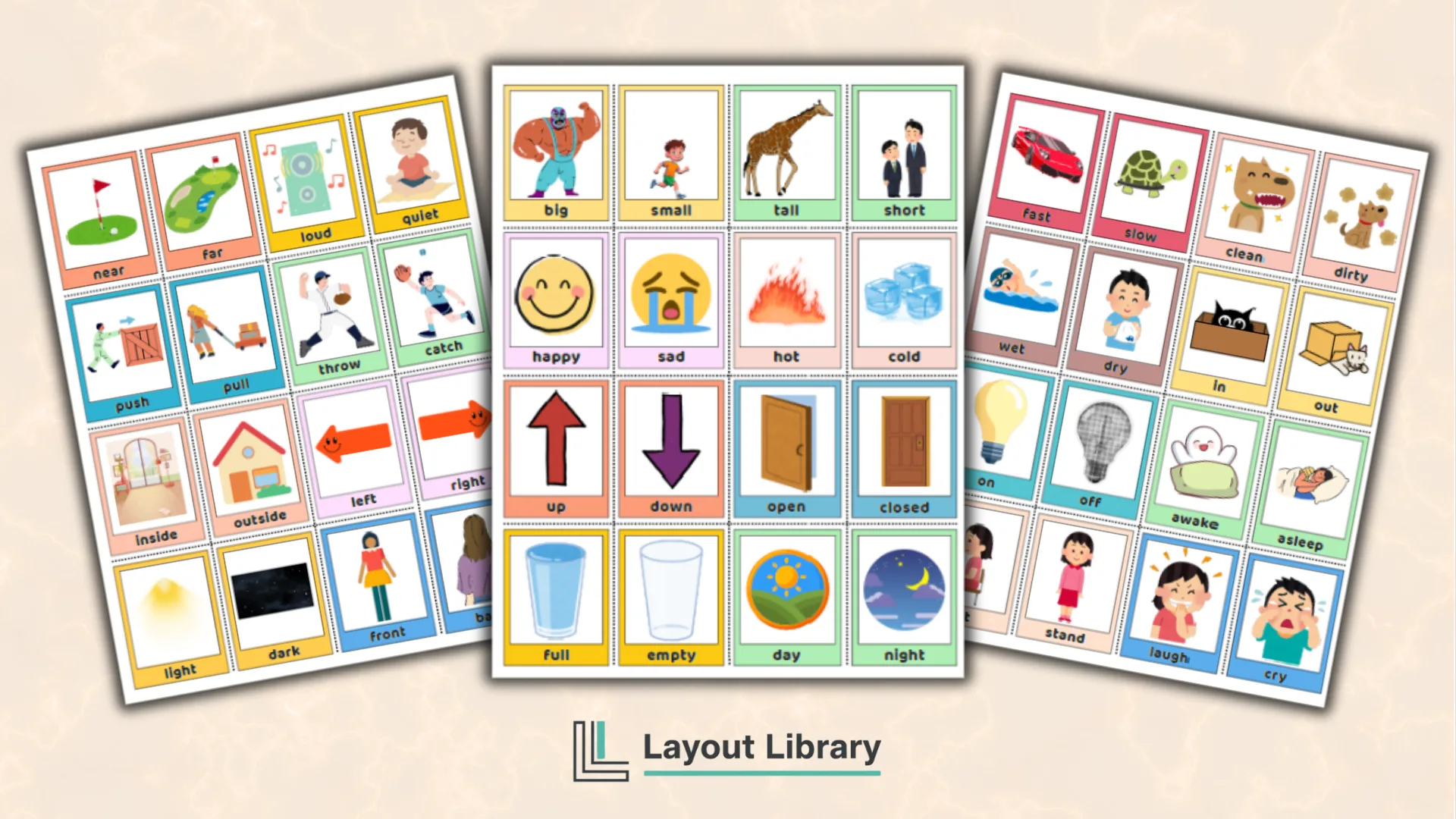
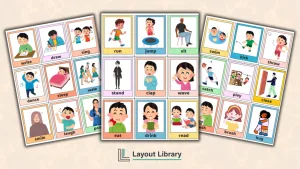
Each card includes a colorful picture and a lowercase vocabulary word. Matching opposites share the same card color and appear beside each other on the printable, making the pairs easy for adults to prepare before mixing them for activities.
The set includes 48 cards across three printable pages, followed by a classroom-use disclaimer page.
Printable Details
Title: Opposites Cards. Used For: Teaching opposite words, building early vocabulary, practicing matching, and supporting visual language activities. Page Length: 3. Paper Size: 8.5 × 11 in (portrait). File Size: 4.53 MB. File Type: PDF. Color: RGB. License: Personal, classroom, and homeschool use.
Start with four or five familiar pairs before introducing the complete set.
Matching colors provides an optional visual clue for children who are new to opposites.
Use the flash cards face up for beginner activities and face down for memory games.
Ask children to describe each picture before revealing or discussing its opposite.
Sort the cards into groups such as emotions, positions, actions, sizes, and conditions.
Print on cardstock or laminate the pages when the cards will be reused frequently.
Store each set in an envelope, small box, or zippered classroom pouch.
Overview
The printable contains 48 picture cards representing 24 opposite pairs. Sixteen cards appear on each of the three main pages in a four-by-four arrangement.
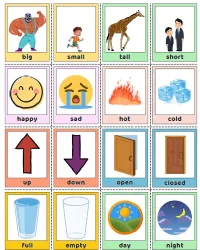
The first page focuses on highly familiar concepts: big and small, tall and short, happy and sad, hot and cold, up and down, open and closed, full and empty, and day and night.
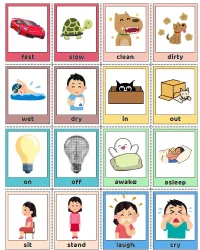
The second page introduces additional descriptive words, conditions, and actions: fast and slow, clean and dirty, wet and dry, in and out, on and off, awake and asleep, sit and stand, and laugh and cry.
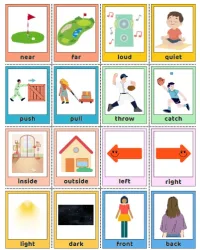
The third page contains concepts that may require a little more discussion or demonstration: near and far, loud and quiet, push and pull, throw and catch, inside and outside, left and right, light and dark, and front and back.
Each pair uses the same background or accent color, helping children identify which cards belong together. The pictures provide visual examples of the words, while the large lowercase labels reinforce early word recognition.
The fourth page contains the personal, classroom, and homeschool-use notice.
How to Prepare the Opposites Cards
Print the first three pages on standard U.S. Letter paper. Regular printer paper works for occasional activities, but cardstock will make the cards sturdier and easier for preschoolers to handle.
Cut along the dotted lines to separate the cards. Adults should prepare the cards for younger children or supervise cutting when appropriate.
For a reusable classroom or homeschool set, laminate the pages before cutting. Rounded corner punches can also soften the card corners, although this step is optional.
Keep each opposite pair together while preparing the set. Once all the cards are cut, shuffle them before beginning a matching activity.
Ways to Use the Cards
For a basic matching game, place several cards face up and ask the child to match each word with its opposite.
Begin with obvious pairs such as big and small or happy and sad. Add harder concepts once the child understands how the activity works.
You can also display one card and ask the child to find its match from a small selection. The matching colors can remain visible as a clue, or you can cover the colored areas for a more challenging activity.
To play a memory game, select several complete pairs and place them face down. Players take turns flipping over two cards and keeping any opposite pairs they find.
The cards can also support speaking practice. Show one picture and ask questions such as:
What do you see?
What word describes this picture?
What is the opposite?
Can you use the word in a sentence?
Can you find something nearby that shows the same idea?
Action pairs such as sit and stand, push and pull, or throw and catch can be practiced through movement.
Positional words such as in and out, inside and outside, or left and right work well with toys, boxes, classroom objects, and simple directions.
Tips for Teaching Opposite Words
Introduce the easiest pairs first. Children may quickly understand physical differences like tall and short, while words such as near and far or front and back may need additional examples.
Use real objects whenever possible. A full cup and an empty cup, an open box and a closed box, or a light switched on and off can make abstract vocabulary more concrete.
Keep each lesson short. Preschool learners may benefit more from practicing a few pairs repeatedly than from reviewing all 24 pairs at once.
Encourage children to explain their choices. Even a brief response helps strengthen vocabulary, observation, and speaking skills.