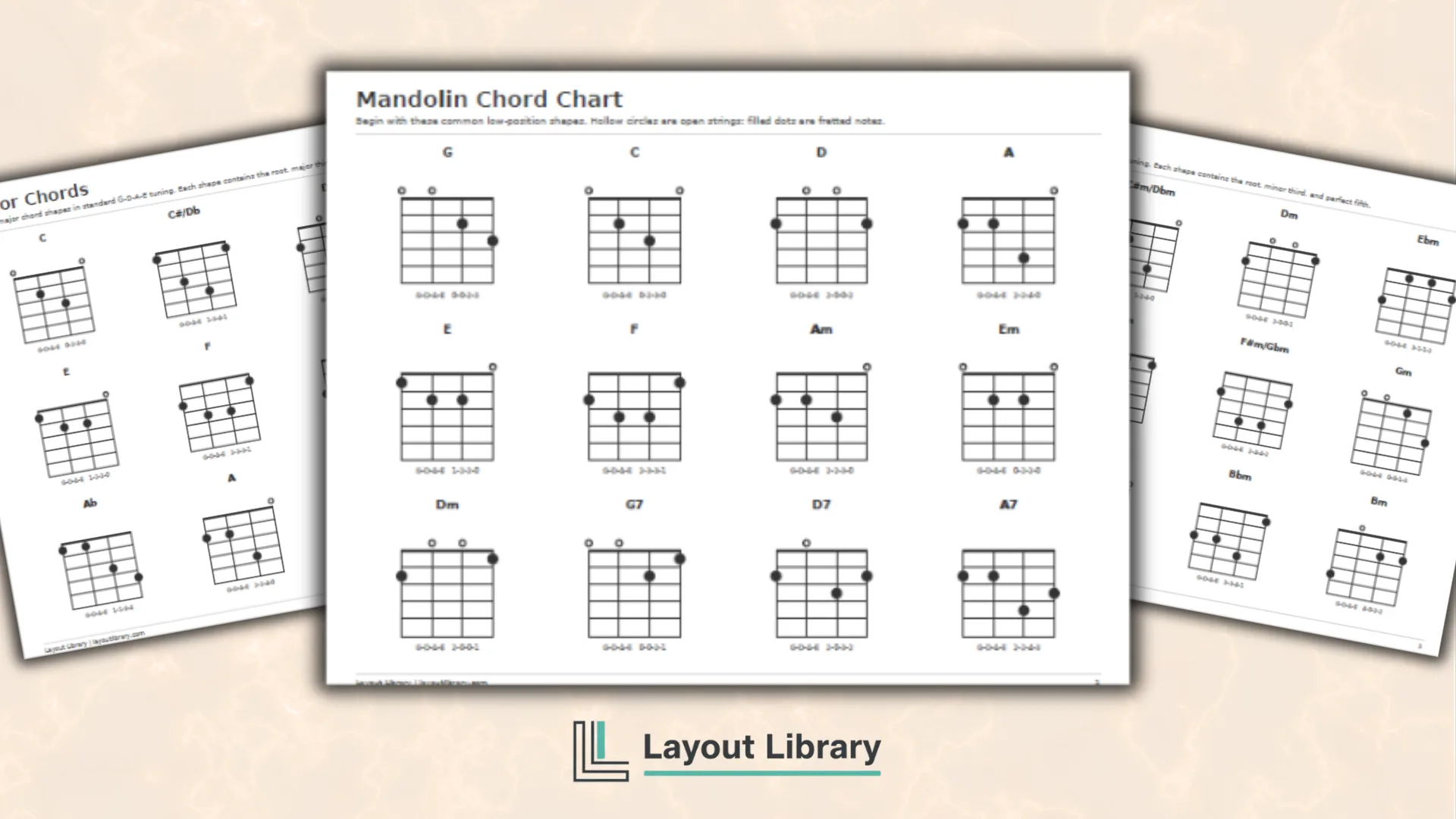
Learning mandolin chords feels easier when the shapes are organized in one clear reference.
This Free Printable Mandolin Chord Chart gives you practical low-position fingerings for practice, lessons, jam sessions, and songwriting.
Keep it nearby while you build smoother chord changes and become comfortable playing in several common keys.
The pages move from a beginner quick-start chart into major, minor, and dominant seventh collections.
A final progression guide shows how chord families work together, so you can practice musical movement instead of memorizing isolated shapes.
Printable Details
Title: Mandolin Chord Chart.
Used For: Chord practice, music lessons, jam sessions, accompaniment, songwriting, and progression study.
Page Length: 6.
Paper Size: 8.5 × 11 in (landscape).
File Size: 67 KB.
File Type: PDF.
Color: Black & White.
License: Personal Use.
Image Gallery
At a Glance
A Practical Mandolin Chord Reference
This chart focuses on usable low-position voicings rather than overwhelming you with every possible inversion.
Each diagram represents the mandolin’s four string courses from G to E.
The selected shapes stay within the first few frets, making the pages especially helpful for beginners and advancing players who want a dependable review.
What’s Included in the Printable
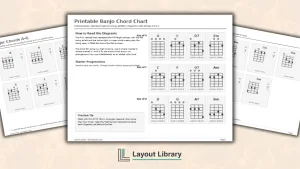
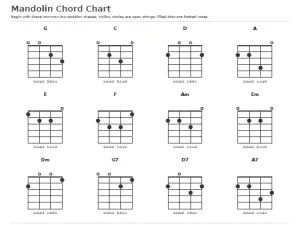
Page one collects twelve frequently used shapes, including G, C, D, A, E, F, three minor chords, and three dominant sevenths.
It works well as a first-page reference when you are learning accompaniment patterns or preparing for a casual jam.
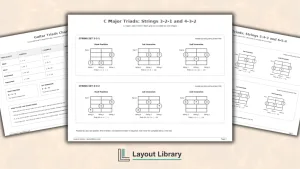
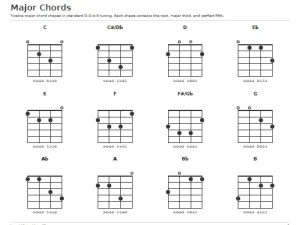
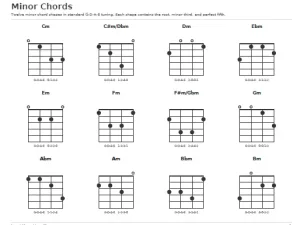
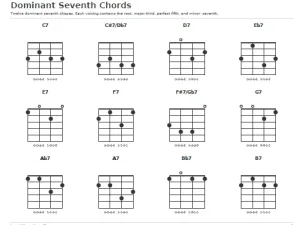
The next three pages organize all twelve chromatic roots by chord quality. You receive one page each for major chords, minor chords, and dominant seventh chords.
Keeping each quality together makes comparison easier and helps you notice how shapes shift or change across the fretboard.
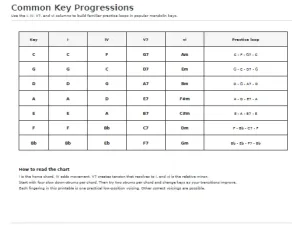
The fifth page turns the chord library into practical music. It lists the I, IV, V7, and vi chords in seven useful keys, then gives a simple I-IV-V7-I loop for each key.
These progressions create focused practice without requiring a separate song or exercise book.
How to Read Each Chord Diagram
The four vertical lines represent the G, D, A, and E string courses from left to right. A hollow circle above the nut means that course is played open.
A filled dot shows the fret to press. The five horizontal spaces represent the first five frets.
Every diagram also includes a four-number code beneath it. Read those numbers in G-D-A-E order. A zero means open, while another number identifies the fret. For example, the G major code 0-0-2-3 means open G, open D, second-fret A, and third-fret E.
The diagrams show one valid low-position voicing for each chord. Mandolin chords have other correct shapes and inversions, so use these pages as a reliable starting reference.
Ways to Practice With the Chart
Begin with two chords from the quick-start page and alternate slowly between them. Hold each shape long enough to check that every course rings clearly.
When the transition feels controlled, reduce the pause, add a steady down-strum, and gradually increase your tempo.
Next, use the progression page. Choose one key and play four slow strums on I, IV, V7, and I. Repeat the loop until the chord changes feel predictable.
Then try two strums per chord or include the vi chord to create a longer, more varied sequence.
Printing and Setup Tips
Print the PDF on standard US Letter paper using landscape orientation and actual-size or 100-percent scaling.
Avoid fit-to-page settings that may shrink the diagrams unnecessarily. Regular printer paper works well for a music stand, binder, lesson folder, or practice desk.
For frequent use, place the pages in sheet protectors or laminate them. You can mark current practice chords with a dry-erase pen, circle difficult transitions, or track the keys you have reviewed without changing the original pages.