Following the Bible’s story across dozens of books can feel overwhelming when people, kingdoms, and turning points appear far apart.
This printable Bible timeline brings the major events into one sequence, helping readers see how Genesis, Israel’s history, the Gospels, and Acts connect.
It works as a reference without forcing disputed dates into the earliest biblical narratives.
Printable Details
Title: Bible Timeline. Used For: Bible study, Sunday school, homeschool lessons, family devotion, church groups, and classroom reference. Page Length: 7 pages. Paper Size: 8.5 × 11 in (landscape). File Size: 58 KB. File Type: PDF. Color: Black & White. License: Personal Use.
Follow eight major biblical eras from Creation through the growth of the early church.
Use one panoramic overview to understand the full sequence before exploring detailed era pages.
Connect every featured event to a clear Scripture reference for faster personal study and teaching.
Review thirty major milestones without squeezing dense text into a single hard-to-read chart.
See approximate historical context only where it helps, with uncertainty clearly identified for readers.
Print clean black-and-white pages that remain readable for binders, classrooms, and group discussion.
Compare the kingdom, exile, restoration, Gospel, and Acts periods through a consistent visual structure.
A Clear Overview of the Biblical Story
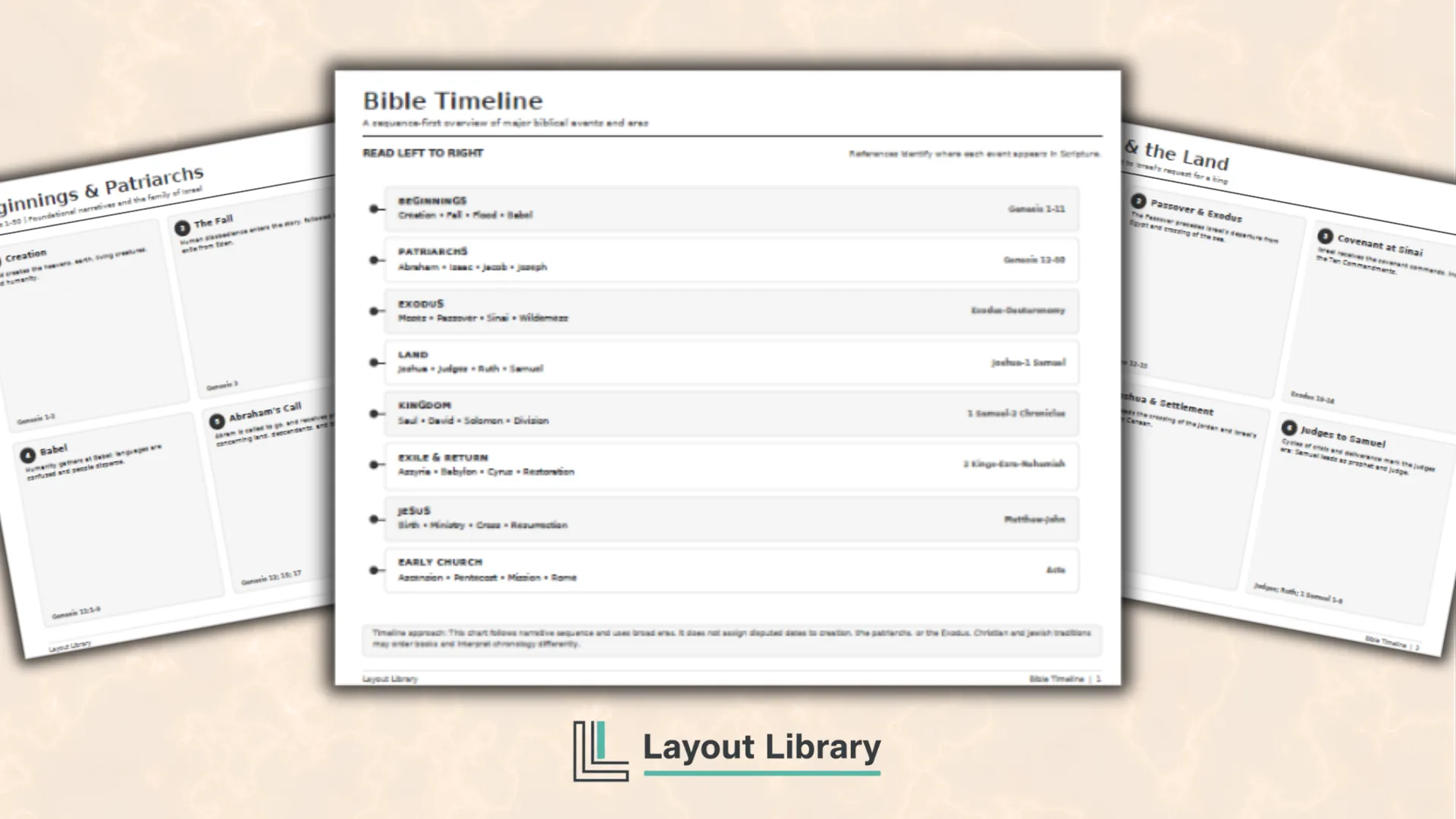
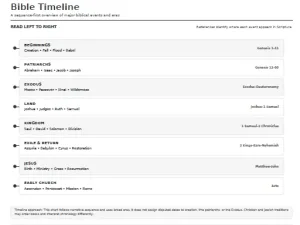
The first page of the PDF provides a panoramic path through eight broad eras: Beginnings, Patriarchs, Exodus, Land, Kingdom, Exile and Return, Jesus, and the Early Church.
Each band names several memorable milestones and points to the main biblical books where that part of the story appears.
This overview is useful before beginning a new reading plan or Bible study. Instead of treating every book as an isolated unit, readers can place familiar names and events within the larger movement of the narrative.
The remaining pages then expand the five major sections without turning the timeline into a crowded wall chart.
What the Timeline Includes
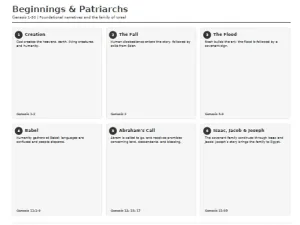
The Beginnings and Patriarchs page moves from Creation and the Fall through Noah, Babel, Abraham, Isaac, Jacob, and Joseph.
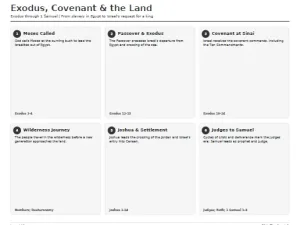
The next page follows Moses, Passover, Sinai, the wilderness journey, Joshua, the judges, Ruth, and Samuel as Israel leaves Egypt and enters the land.
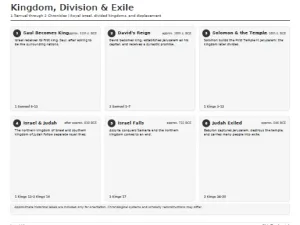
The Kingdom, Division, and Exile page introduces Saul, David, Solomon, the divided kingdoms, Assyria’s conquest of the northern kingdom, and Babylon’s destruction of Jerusalem.
Approximate historical labels appear here for orientation, while a note reminds readers that chronological systems and scholarly reconstructions can differ.
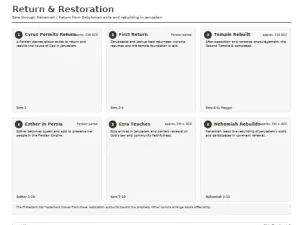
Return and Restoration highlights Cyrus’s decree, the first return, rebuilding the temple, Esther’s story in Persia, Ezra’s teaching, and Nehemiah’s work in Jerusalem.
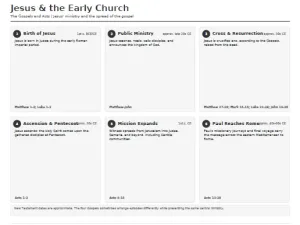
The final era page follows Jesus’s birth and ministry, the cross and resurrection, the ascension, Pentecost, the widening mission, and Paul’s arrival in Rome.
How to Use This Bible Timeline
Start with the overview page and identify the era connected to your current study. Then turn to the matching detailed page and read the event cards in numbered order.
The card references make it easy to open your preferred Bible and examine the surrounding passage rather than relying only on the summary.
For teaching, choose one era per lesson and ask learners to locate each event in Scripture. Students can add dates, people, themes, or notes in a separate notebook.
Families can keep the overview near a reading area and use the detailed pages to introduce the context for weekly devotion.
The landscape format also works well inside a binder using sheet protectors. Print at actual size for the clearest text. If a printer automatically shrinks landscape pages, select fit to printable area and confirm that all four margins remain visible before printing the full set.
FAQ
No. It intentionally omits disputed dates for the earliest narratives and uses only broad approximate context for selected later periods. The emphasis stays on event sequence and Scripture references, making the chart useful without claiming that every chronological question has one universally accepted answer.
The page sequence broadly follows the narrative flow familiar to readers of Protestant Christian Bibles, while acknowledging that Jewish and other Christian canons arrange books differently. The included references let readers study each event using the Bible translation and tradition they prefer.
Yes. The layout supports personal study, family devotion, homeschool lessons, Sunday school, and small-group discussion. Print the pages for your own noncommercial group use, then pair each era with direct Bible reading, discussion questions, or a separate note-taking activity.