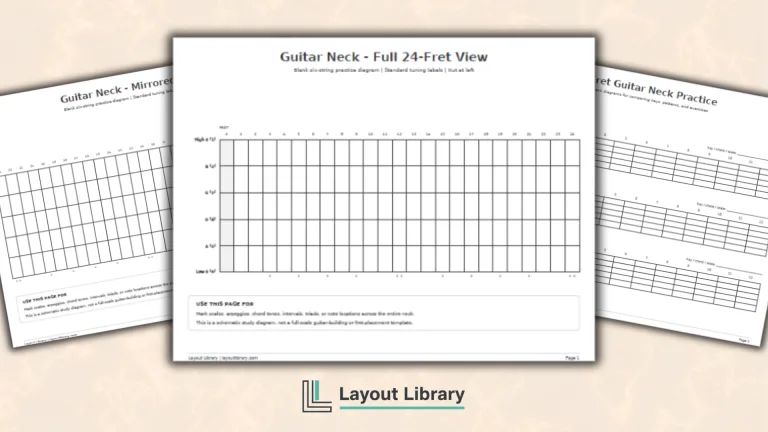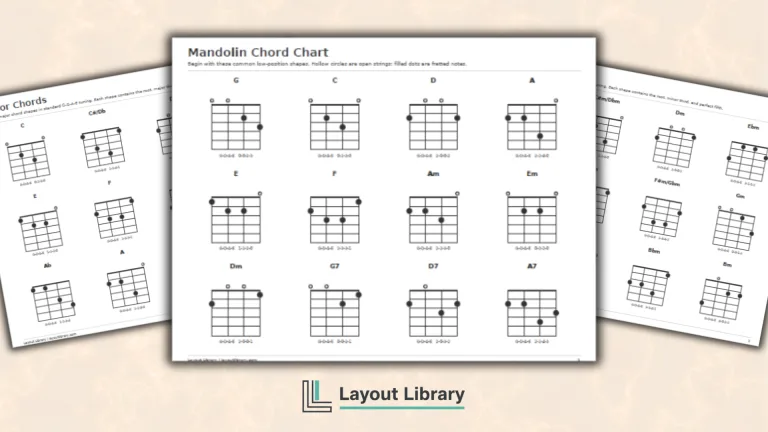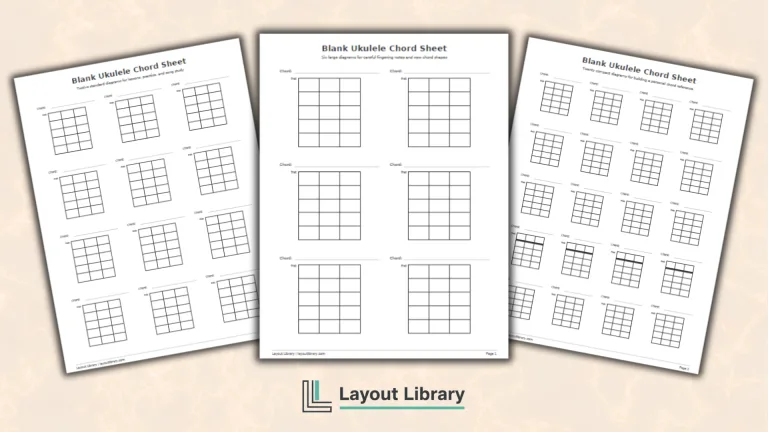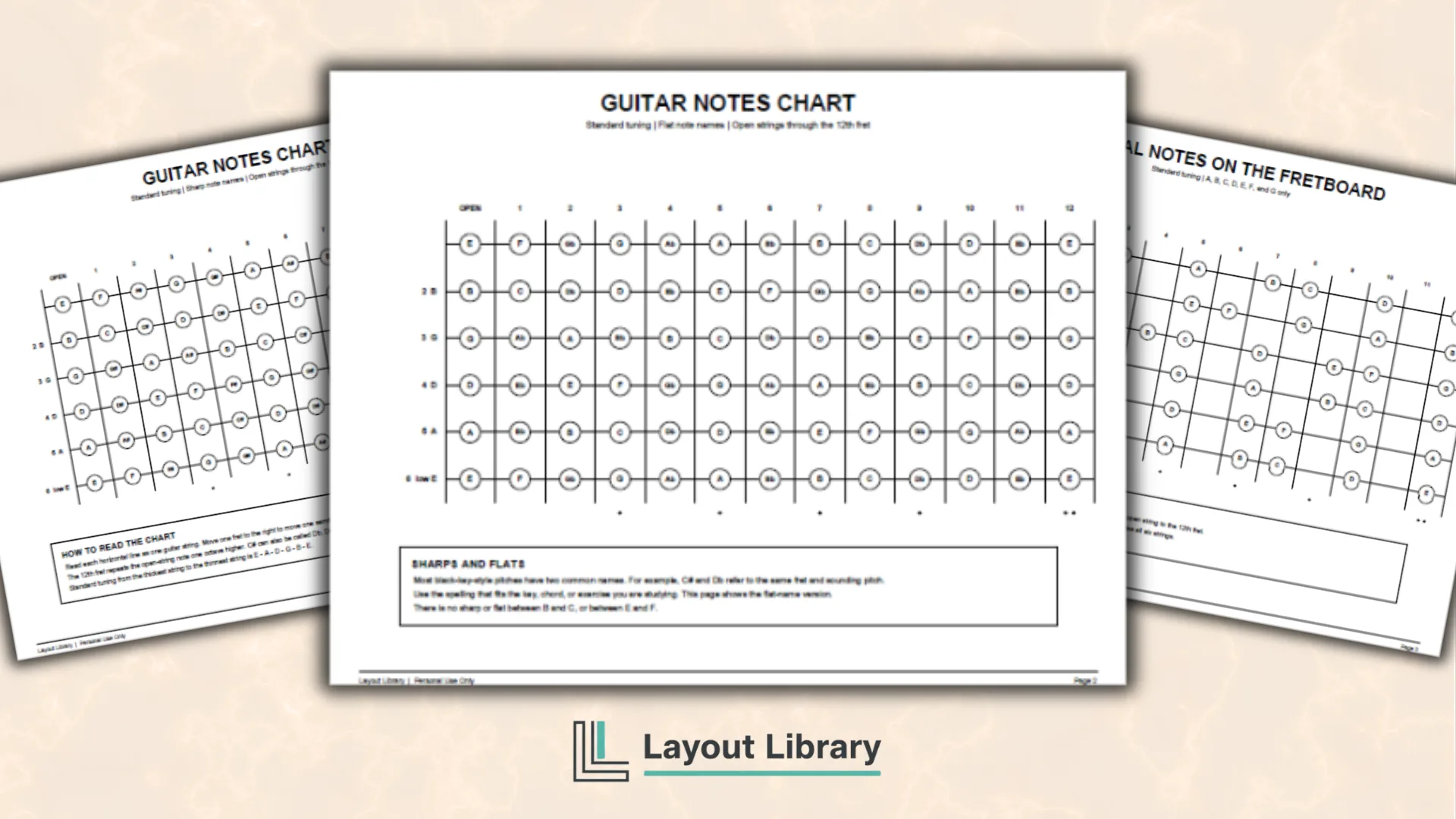
This free printable guitar notes chart gives you a clear reference for the open strings through the 12th fret, along with focused pages that make memorization and practice more manageable.
The packet is designed for a standard six-string guitar in E-A-D-G-B-E tuning.
Keep it on a music stand, place it beside your practice notebook, or use the blank diagrams to test what you remember.
Printable Details
Title: Guitar Notes Chart.
Tuning: Standard six-string guitar tuning.
Page Length: 5.
Paper Size: 11 x 8.5 in (landscape).
File Size: 26 KB.
File Type: PDF.
Color: Black & White.
License: Personal Use.
Image Gallery
At a Glance
What Is Included in This Guitar Notes Chart?
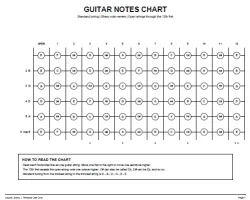
The first page maps every note from the open strings through fret 12 using sharp names such as C#, D#, F#, G#, and A#.
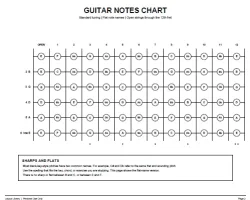
The second page shows the same physical note locations with flat spellings such as Db, Eb, Gb, Ab, and Bb.
These two charts are useful because one fret can have two common note names. C# and Db, for example, refer to the same sounding pitch and the same location on the fretboard.
The preferred spelling depends on the key, chord, scale, or exercise you are working with.
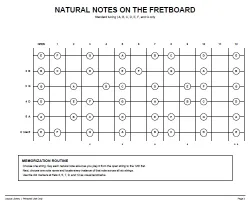
The third page removes the sharps and flats so only the natural notes A through G remain. This simpler view makes a strong starting point for beginners.
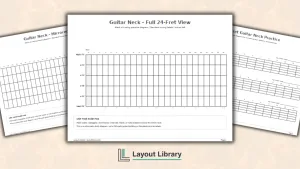
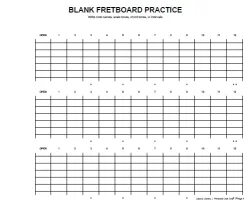
The fourth page contains three blank fretboards for writing note names, intervals, scale degrees, or chord tones.
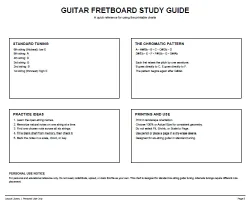
The final page provides standard tuning, the chromatic note pattern, practice ideas, and printing instructions.
How to Read the Fretboard Diagram
Each horizontal line represents one guitar string. The thinnest high E string appears at the top, followed by B, G, D, A, and the thickest low E string at the bottom.
The leftmost position is the open string. Each step to the right represents one fret and raises the pitch by one semitone.
The musical alphabet follows a repeating chromatic pattern. Most neighboring natural notes have a sharp or flat between them.
The two exceptions are B to C and E to F, which sit directly beside each other. At fret 12, every string returns to its open-string note one octave higher.
Easy Ways to Practice Fretboard Notes
Begin by memorizing the six open-string names. From the thickest string to the thinnest, they are E, A, D, G, B, and E.
Then choose one string and learn only its natural notes. Say each note aloud as you play it, and use the fret markers at 3, 5, 7, 9, and 12 as landmarks.
Another effective exercise is to choose one note, such as C, and find every C across all six strings. Once that becomes comfortable, repeat the exercise with a different note.
You can also place the printed blank page in a dry-erase sleeve and complete it repeatedly without printing extra copies.
Printing Tips
Download the PDF and open it in a reliable PDF reader. Select US Letter paper and landscape orientation.
Print at 100% or Actual Size for the intended proportions. Avoid Fit, Shrink, or Scale to Page unless your printer requires extra margin space.
Plain printer paper works well for everyday practice. Cardstock is useful when you want a sturdier reference for a music stand or lesson binder.
You can also laminate a favorite page or place it in a sheet protector for repeated use.